

The Goal Crusher Guide
You have so much to do, and you're not sure where to start.
Well...you've come to the right place.
Let's take a look at the 3 parts of the goal crushing process.
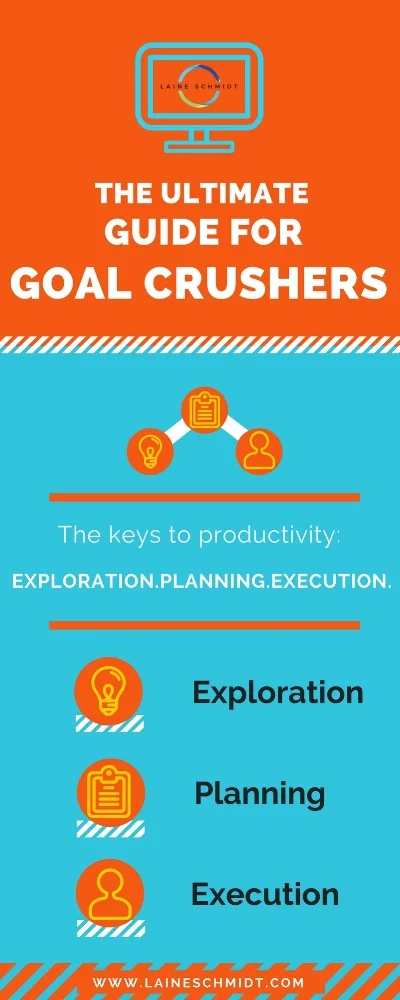
Step 1: Exploration:
This is the time you take to determine your goals, consider your obstacles, and make decisions based on your hopes, dreams and desires. Meeting sales quotas, starting a new project, lifestyle changes, anything you are trying to accomplish, requires time. The small amount of time set aside to brainstorm the dynamics of your goal are insignificant when compared to the focus it provides. The hardest part of this activity, is blocking off and committing to a solid amount of time when all you do is think. Knowing where you are going, and how to prevent certain things from getting in your way, will give you a sense of excitement as you begin to see great things ahead.
2. Planning:
As my boy Abe Lincoln once said, "Give me 6 hours to chop down a tree, and I will spend the first 4 sharpening the axe." In the planning part of the process you will begin to lay out specific details of what resources you will need, how you will get them, and how and when you will use them. You will take inventory of your human resources as well, laying out clear plans of who will be involved and how. Magic happens when your planning is undertaken with great thought and detail. Don't let ambiguity get in the way of a clear plan of action.
3. Execution
Now that you have determined your goals and planned out your action steps, the execution stage has been simplified. Execution is your path to change. Moving into this stage, having the tools you have created during exploration and planning, you are equipped with what you need to succeed. It is important to get in the mindset of hard work and resilience, as a lot of time and energy will be required and surprises will be thrown your way. Keep moving. Stick to the plan. Allow yourself certain flexibilities; while you can't control those around you, you can commit to doing your part with excellence. If the details of your plan have to change, roll with it and find another way that works. Execution depends on you and your determination. Those who execute well reap great rewards.
If the idea of crushing your goals excites you, and you need someone to help you explore, plan and execute, I would be happy to discuss the best course of action to get you where you want to be.
Maintaining Healthy Growth at Work
The most successful individuals are those that never stop growing. They welcome the many factors that contribute to growth and keep a healthy perspective in regards to why and how growth is achieved. There are many ways we can develop as professionals; today we will touch on three of them:
1. Embrace Change
Work cultures and practices are constantly changing; you should be, too. When new programs, new colleagues, or new leadership are introduced, consider the benefits that will emerge as a result. Change can be daunting, but it is going to happen. You have to decide if you are going to roll with it and make the best of a new situation, or fight against it and make known your disapproval. If you choose the former, you will likely be seen as someone who is flexible, and keeps the best interest of the company as a number one priority.

2. Welcome Feedback
Growth begins when we willingly assess our strengths and weaknesses. With that, we are confirmed in what we do well, but also have to face some hard truths about how we can improve. To receive feedback gracefully, keep a healthy perspective. Remember that the feedback is being given to you because your employer feels you are worth investing in; you are an asset. Every great asset requires development. History is teeming with stories of people who had to receive some hard truths and work to overcome them before achieving greatness: Walt Disney, J.K. Rowling, Bill Gates, and Thomas Edison, just to name a few. You can read about them here. If you are also receiving feedback that will help you improve, consider it an honor and a great opportunity.
3. Make Time for Learning
You have the framed diploma(s) on the wall, and that should represent the beginning of your academic accomplishments. With the change you are now embracing, and the feedback you have gracefully received, how can you learn about and implement new ways of doing things? Reading changes the way we perceive our work and offers insight into how we can bring about change and excellence in what we do. From the CEO to the intern, reading is a necessary way for everyone to grow and connect. Continuing education has many faces, whether that is in a book, a course, or a mentorship, there are innumerable resources available to you.
Looking to create healthy growth in your work? Let's talk!

Do This for 15 Minutes, and You Will Save Hours.
You’re working hard. You’re working often. Still, things are not as you hoped they would be. You end up feeling discouraged, overwhelmed, totally wiped. Many people think in order to reach goals, we must work harder. That’s not always the case; instead, we need to create systems to help us work smarter.
Systems streamline, saving time.
Systems remove the guesswork, saving stress.
I explore this concept with my clients day after day. Creating systems, for the big stuff, and the small stuff, can streamline your life and help you to feel a huge sense of relief from the everyday chaos. When you wake up in the morning, is there an order in which you get ready for the day? I bet there is. If that order of things is disrupted, what does it cause? Stress? Frustration? A significant amount of bad language? Don’t be ashamed….we’ve all been there.
Our morning routine is a small example of our dependence on the safety and expectations that come from systems. We love them, because they take guessing and decision making out of the equation.

Let’s take an example from some of my superstar clients (names and details have been changed). Erin’s office was covered in piles of papers. When she arrived at her office with new mail, or files, she tossed them down wherever there was an empty area. (Are you getting a nervous itch?) She didn’t think much of it, until her boss started making comments, and she realized how frustrated she was when she couldn’t find things. This was a consistent stressor, because she was unorganized, and she was making a poor impression. After exploring some ideas, she created a system where she puts the papers in a newly purchased paper box, which she can throw into a desk drawer. This might not be an ideal system for everyone, but for Erin, it is a great baby step in keeping her office straight and her sanity intact.
Let’s look at another example from a superstar client named Drew. Drew is the owner of a very successful marketing company. He has recently become frustrated with the company’s lackluster team meetings. He does not usually go in with a clear agenda, and often forgets issues he meant to discuss. After thinking through ideas that suit his personality, he created a system in which he keeps a running list in the notes section of his phone. Whenever he thinks of something to discuss in the meeting, he makes a quick note and moves on. Come meeting time, he has all of his thoughts in one, easily accessible spot. His employees are more engaged, the time together is more productive and he proves that he is capable of great leadership. Seems like a simple solution to many, but it wasn’t something Drew had taken time to consider.

That’s just it. You have to make time to explore solutions. While the solutions you create might be very simple, their effects are substantial. Don’t try to tackle them all at the same time. Pick one, allot 15 or 20 minutes of your day to think through the obstacles and the possibilities, and give it a try.
The Benefits of Having Systems:
- Clarity -
For everyone involved. When we know what is expected of us, and what to expect from others, things run much smoother. With clarity, we promote better work and home environments; it offers a better way to get things done.
- Productivity -
Much of the reason we don’t accomplish things is because we don’t think about what is required and the best way to get there. Systems give us a map to the end goal.
- Order -
Chaos ensues when there is no plan. When effective systems are in place, all of the moving parts are able to work efficiently and without the conflict, which comes from disorder.
The beauty of systems is how they interact with one another. Your systems at home overflow into your systems at work. If you have a plan in place to consistently get out of bed on time, that will get you to work on time. They work in collaboration with each other, which is why it’s important to consider the many parts of our lives that could be improved by these small changes. We must be willing to revamp our systems. Don’t become discouraged if the first one you try doesn’t work….try another one. You have to find a fit that is appropriate for you, as they look different for each individual.
If you are at a point where you want to explore systems that will help you organize your life and accelerate your plans, I would love to offer you a free consultation.

Principles to Practice When Positioning Yourself for Leadership
There are many factors that contribute to the rise of professionals in their careers, yet these four principles, when practiced consistently, will prepare you for the leap into leadership:
1. Listen Well: People who problem-solve well, are people who listen well. People who earn respect, are people who listen well. People who communicate interest and commitment, are people who listen well. But, what is listening well? It is listening without judgment, and listening to understand, not to respond. If you ask a question, and then catch yourself crafting a response to the answer before they have finished talking, you are not listening well. While someone is talking, we should be listening so intently, that the only things popping into our heads should be follow up questions to what they are saying, so that we can further understand what they are trying to communicate. Listen deeply, and listen with intent, and people will come to appreciate that you care about their concerns, and not just your own.

2. Lead with Service: The idea of servant leadership is becoming increasingly more prominent, as people in a variety of industries are experiencing its positive effects. When leaders are seen as individuals who care about the people with whom they work, they are trusted. As leaders, if we cannot put aside our own wants to ensure the concerns of others are addressed, the needs of those people won’t be met and their work will suffer. As Lawrence D. Bell once said, "Show me a man who cannot be bothered to do little things and I'll show you a man who cannot be trusted to do big things." If you desire to be a leader, first concentrate on how you can build up the people around you, and do so with genuine care. The faithfulness of your actions will foster personal growth, and people will feel you are approachable and trustworthy.
3. Be Teachable: There will never be a time when we have become such experts, that we have learned all there is to learn. Ideas are always evolving, culture shifting, businesses transitioning and thanks to modern-day technology, the knowledge required to keep up with all of that is at our fingertips. Take advantage of the wisdom of others. If you’re not at the top of the food chain, welcome the knowledge of those who are. Seek out a mentor, a coach, new resources that will become part of your ongoing personal and professional development.

4. Don’t Grumble, Strategize: You’ve got a problem? Great…do you also have a possible solution? People who can identify weaknesses or missing links, play a vital role in the health and growth of a team. It is how they present those findings that sets them apart. Go before your listeners with your observation, and ask if they would like to hear some viable solutions. Create a reputation as one who can pinpoint obstacles, and create workable plans to help your team get to where they want to be.
Your interaction with others and the effort you put into your work will determine how others view you. Good leaders are consistently evaluating themselves and taking inventory of character development and work ethic. We are not born with exemplary character; it is something we have to intentionally practice. Your practice will be well worth the effort.