
Personal Internal Management Tools for Overseeing Stress
BY: COACH JOHN HOUMES

We are in a new normal. Every day is full of ambiguity and shifting challenges.
Many people are asking, “How do I keep the momentum going?”
Owners are asking this about their businesses, professionals about their careers, and entrepreneurs about their projects.
Do you see the tension? Everyone wants to keep moving forward and advancing in a world that changes every few days.
This tension produces stress, anxiety and exhaustion.
How are you doing with personal internal management? How are you handling the stress? The anxiety? The exhaustion?
One of the pitfalls of this season is to ignore how you’re doing internally and just keep pushing forward. But, personal internal management may be the very key to keeping your momentum.
So, how do you oversee your stress and manage the anxiety of this season? Here are a few things to consider:
1. Recognize That Everything Has Changed
Let’s say that your career, business or project was like driving a sports car going 75mph down the interstate. You could hit the gas, move around traffic and get where you wanted to go, besides the times you had to sit in traffic.
This season is more like driving an econo-car on a slick back street full of potholes, speed bumps and sharp turns. Recognizing the change is crucial. If you drive that econo-car like the sports car on the interstate, you will ruin it. It may get through it, but it will come out the other side with some permanent damage.
You’re the same way. You can’t operate in this season like you did in the last. Things that were easy are going to be hard. Tasks that didn’t take much energy may exhaust you. This is all normal in the midst of this challenging season. But, if you try and just push through it, you will eventually run out of momentum from sheer exhaustion.
Write down everything that is different about your work, relationships, and home life from two months ago. Count how many things have changed. Take a moment to let that sink in.
2. Decipher Between the Controllable and Uncontrollable
Stress is only added when you confuse something you can control with something you can’t. You can call your clients, show concern for them, and show them your value, but you can’t force them to hold on to your service.
You can push marketing on social media and respond to those who are interested, but you can’t control the fact that your revenue is falling.
You can control how you behave, act and think, but you can’t control what others do.
Does deciphering between the two really matter? Yes! Because much of your stress comes from getting the controllable confused with the uncontrollable. If you find yourself focused on one particular thing, ask if it is something you can or can’t control. If you can’t, detach your thoughts from it and move onto something you can control.
You will keep momentum by focusing on the things you can actually change.
3. Don’t Personalize Something That’s Impersonal
Some people are more in tune to relational dynamics than others. For these people, this season may find an added stress: relational loss.
When your favorite client changes their agreement due to their finances, that is stressful enough. But, processing that relational loss adds another level of stress.
Oversee that stress by reminding yourself of the difference between what is personal and impersonal. For instance, remind yourself, “they said they benefited from our service, but they don’t have the money.” This isn’t about us or the quality of our product. It is about their finances.”
Distinguishing the difference between impersonal and personal will help you keep momentum and process the loss in a healthy way. Confusing the two may slow you down as you spend time licking a personal wound that was never meant to be personal.
4. Find a Radical Diversion
Find something that takes you out of your normal and puts you somewhere else mentally. Maybe this is gardening, video games or a conversation about a personal interest. Take the time to find that hobby or activity that helps you escape in a healthy way. This will allow you to recharge. Like a car needs gas to keep going, you must recharge to keep momentum.
Part of keeping momentum during this time could be more about you managing yourself internally than anything else. Watch for emotional exhaustion. Write down what is causing stress, and then use these tools to overcome it.
You want a raise. Where do you start?

You want a raise. Where do you start?
The first place to start is this. Ask yourself as objectively as you can: Have I done what's expected of me? If you've answered no, we commend you for being honest and we recommend you call us so we can dive into that.
If the answer is yes, then consider this: There are two schools of thought on how to ask for a raise.
1. You can either ask for a range. Your lowest number would be the number you really want and your highest number is ambitious, without being greedy. What this shows about you is that you're flexible.
2. You can ask for a specific number. Studies show that employers prefer an unrounded number. For instance, 52,500 is better than 52,000 because what it communicates is that you've done your research.
Neither is wrong. Consider the context and go in with the method that you feel like fits the company culture.
Enjoyed this tip but want to know more?
Work From Home Tips, From Those Who Do It Full Time

You went from a structured, focused place of work to your living room couch. Where you once had someone keeping your time in check, now the only ones keeping dibs on you are your dog, and your hungry child. Working from home is a new reality for millions of us. How can we work from home well? How do we stay focused? How can we be productive? How can we unwind, when there’s no physical disconnect between work and play?
We found work from home pros in a variety of industries, who work remotely full time. They share with us their best tips for how they make it work.
Scheduling:
Jenna Braddock, Dietician Nutritionist and Media Spokesperson:
Honor the morning as the most productive time, do not check your email until after you have finished something you need to do and work on self-awareness.
Milly Hackett, Operations Manager, WheelHaus:
Segment your day. Use a calendar to divide the goals you want to achieve during the day and week. Use apps, like Asana and GoogleCalendar to keep you organized!
Brad Jones, Pastor:
Try to keep some form of routine. Get to bed at a decent hour. Every episode of Tiger King will be there tomorrow. Have a routine to start the day... pace is key. Take breaks. Set start and stop times. Include exercise to break the monotony.
Jenn VanHekken, Enneagram Coach:
Start your workday with a morning routine that is different from your weekend routine. Whether it’s coffee and a work out, reading a specific business journal, or having breakfast with your family, when you start your workday with a consistent rhythm and routine, you will be more prepared and focused for the day ahead.
Organization:
Kate Erickson, Engine @ EOFire:
Remove distractions, set your workspace up for success, and have a plan in place for how you're going to tackle your to-do list every day, then working from home will quickly become your favorite, most productive thing!
Keila Drum, Virtual Assistant:
Work on your discipline. What helps me to stay on task is to map out my whole week in advance. When I see it in front of me, it reminds me to stay focused until I finish my work.
Eddie Ortega, Sales Director:
Stay connected with your team and/or network to stay accountable and constantly be reminded of your mission. This is where a personal coach brings tremendous value especially if you’re working remotely.
Workspace:
Laura Botu, Graphic Design Manager:
The environment I work in really affects my productivity and focus, so I bought some fresh flowers and candles. I love to build a more aesthetically pleasing workspace.
Lauren Arrington, Realtor:
Scheduling time to exercise helps my mind stay clear and gives me energy to tackle the day. Also, having a space solely for work helps me compartmentalize the home responsibilities vs the professional responsibilities.
Gabrielle Compton, Realtor:
Defining a designated workspace that only includes my essential business material is extremely important for me when working from home. This eliminates distractions and provides me with the prime focus I need to complete my workload proficiently.
Erika Diaz, Photographer:
Don’t work from your couch or a comfy spot... whatever you do! Pick a spot and make yourself a workspace. Hide your phone or delete social media apps for the day. Burn a candle, play music. Have a notepad with your to do list or a time block calendar to keep on track with your daily tasks. Get dressed for the day as if you’re going to work.
John Lashbrook, Owner; PixelWorks:
It is critical to have a designated office or work area. Spend a little time to set yourself up so that you can be productive and isolate yourself from the other distractions in your house.
Lauren Sigmond, VP of Operations:
Get a standing desk. It’s so much better for your posture and your whole body. Plus, it keeps you energized. Get an AfterShokz headset. The speakers don't go in your ears so you can listen to music while still listening out for your kids, and switch easily to taking a call. It's also nearly impossible for them to fall off, so you can fit in a yoga break while being on a call with a client.
Working with kids at home:
Heather Holt, Photographer:
Use the mornings to get in about an hour of work while the kids eat breakfast, play, and watch a show. Then it's adventure time...the more you play with them the happier they are, and the easier it is to get some alone time to work in the afternoon.
Chris Tuff, Author:
If you have kids, order an iPad Pro with cell service, so you can deal with bandwidth issues. Also, overcommuniate with everyone.
Christina Morris, Professional Organizer:
Create a family work zone in one room of the house to eliminate constant back and forth. This will also help breaks to feel like real breaks, leaving the space to have movement, snacks or free-play in another area. If working from home is new, try recreating your desk space as it would normally be at your office facing away from any "house chore triggers".
If you’d like someone to help you get organized and maintain productivity, let us know. We’ll get you connected with a coach who will help you create an optimal schedule and strategy to make sure your work-from-home experience is a positive one.
One Way To Get a Handle On Your Planning
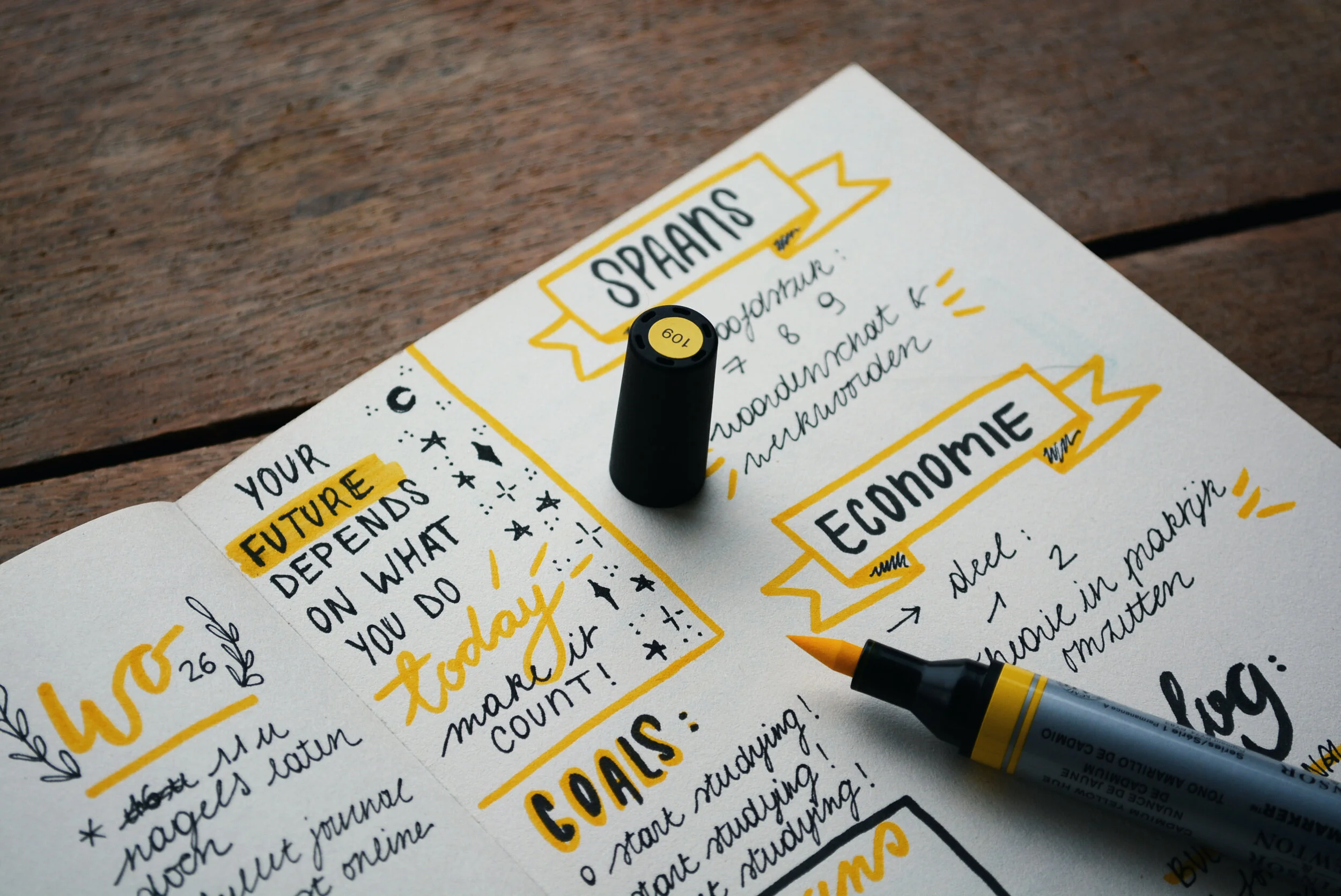
Here’s one way you can get a handle on your planning:
I was recently listening to a podcast and the guest said: "You have to do what's right in front of you and focus on the now.” I thought, "there is a lot of wisdom in that, but how do we focus on the now if we don't know where we're headed?”
How do we establish where we are headed? We write a vision statement.
Vision boards and vision statements aren't just for crafty teenagers and corporate employee handbooks. These are for all of us because it gives us the picture of where we want to be and then we know how to get there.
There is a study recently by Gale Matthews at the University of California, and it found that people who wrote down their future desired state were 42% more likely to achieve it.
Let's be a part of that statistic.
Your vision should have three components:
1- It should be realistic. - We want to make sure that we set ourselves up for success.
2- It should be really specific. - Write down when it is, who we're with, what we're doing and why we're doing it. You should see it in your mind.
3- It should incite emotion. - This should make you feel something: excitement, fear, etc...
If you don't feel something when you're imagining what your future is going to look like, rewrite it.
Fun fact: Goals and visions are different. Goals are the steps we take to reach our visions.
Especially now, as companies across the world are pivoting due to COVID-19, it’s essential that you know the vision for yourself and your business. That way, every change we make will be through the lense of that vision; it makes the decision-making process much easier.
If you need help establishing your vision, contact us today and we’ll help you craft a vision statement and put plans in place to get you started on your way.